Manufacturer of Hygienic Food Grade Quick-Install Butterfly Valve

working principle:
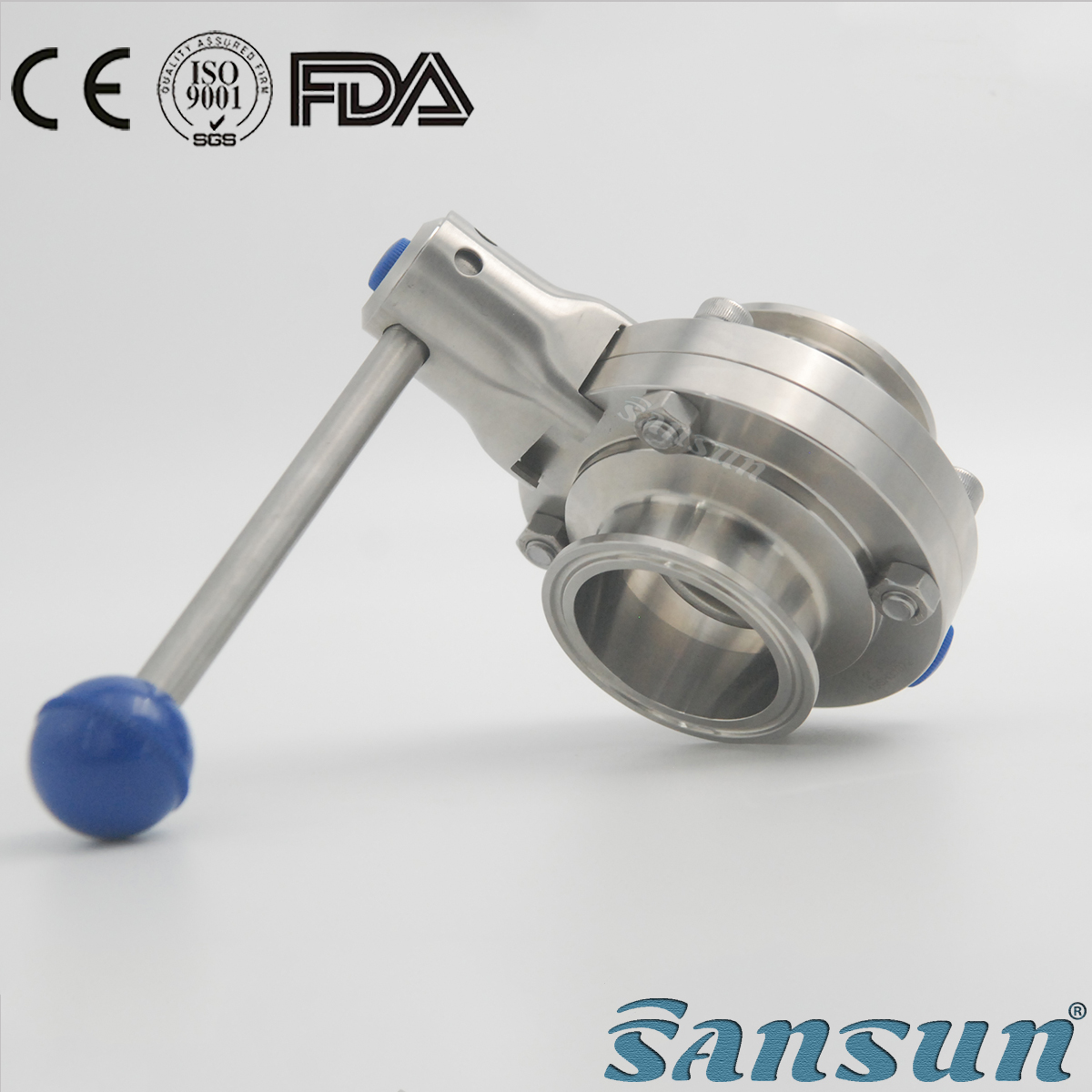
The sanitary quick-install butterfly valve is a stainless steel valve that uses a circular butterfly plate as an opening and closing part and rotates with the valve stem to open, close and adjust the fluid passage.
The butterfly plate of the sanitary quick-install butterfly valve is installed in the diameter direction of the pipeline. In the cylindrical passage of the stainless steel butterfly valve body, the disc-shaped butterfly plate rotates around the axis, and the rotation angle is between 0° and 90°. When the rotation reaches 90°, the valve is fully opened.

Sealing of sanitary quick-install butterfly valve: The sanitary quick-install butterfly valve is a centerline stainless steel soft-sealed butterfly valve. Its sealing principle is to ensure that the sealing surface of the sanitary quick-install butterfly valve has a suitable surface roughness value during processing. Synthetic rubber valve The seat forms a suitable surface roughness value for the sealing surface during compression molding.
When the stainless steel butterfly valve is closed, through the rotation of the valve plate, the outer sealing surface of the valve plate squeezes the synthetic rubber valve seat, so that the synthetic rubber valve seat produces elastic deformation. The elastic force is used as the sealing pressure to ensure the sealing of the valve.

Application: Sanitary fast-installed butterfly valve is specially used in dairy products, food, pharmaceutical, beer, cosmetics and other industrial fields.

For more detailed information, please visit our website http://www.sansunstainless.com or contact us at sansun05@sansunstainless.com.

food grade stainless steel butterfly valve

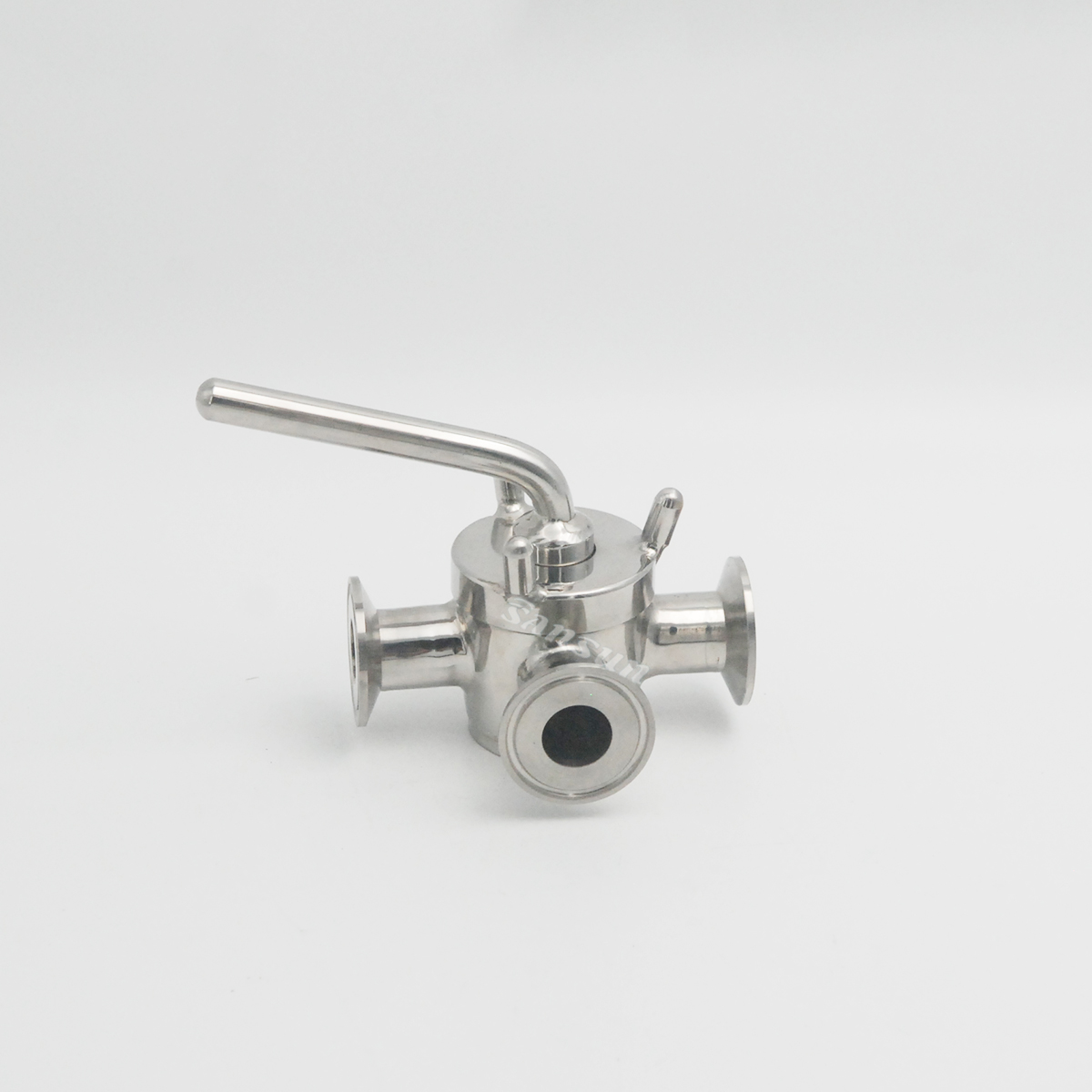
SANSUN Professional Manufacturer of Food Grade Plug Valve/Stopcock Valve

The plug valve is a shut-off or plunger-like rotary valve. The channel opening on the valve plug is the same as or separated from the channel opening on the valve body by rotating 90° to achieve opening or closing.

The shape of the plug of the plug valve can be cylindrical or conical. In a cylindrical valve plug, the channel is generally rectangular; in a tapered valve plug, the channel is trapezoidal. These shapes make the structure of the plug valve lighter, but at the same time it also produces a certain loss.

The plug valve is most suitable for shutting off and connecting the medium and for diversion, but depending on the applicable properties and the erosion resistance of the sealing surface, it can sometimes be used for throttling.

Since the movement between the sealing surfaces of the plug valve has a wiping effect, and it can completely prevent contact with the flowing medium when it is fully opened, it can usually be used for medium with suspended particles.

Another important feature of the plug valve is that it is easy to adapt to the multi-channel structure, so that one valve can obtain two, three, or even four different flow channels. This can simplify the design of the piping system, reduce the amount of valves and some connection accessories required in the equipment.

For more detailed information, please visit our website http://www.sansunstainless.com or contact us at sansun05@sansunstainless.com.

sanitary stainless steel plug valve

Factory/Manufacturer of Sanitary Stainless Steel Reversing Valve

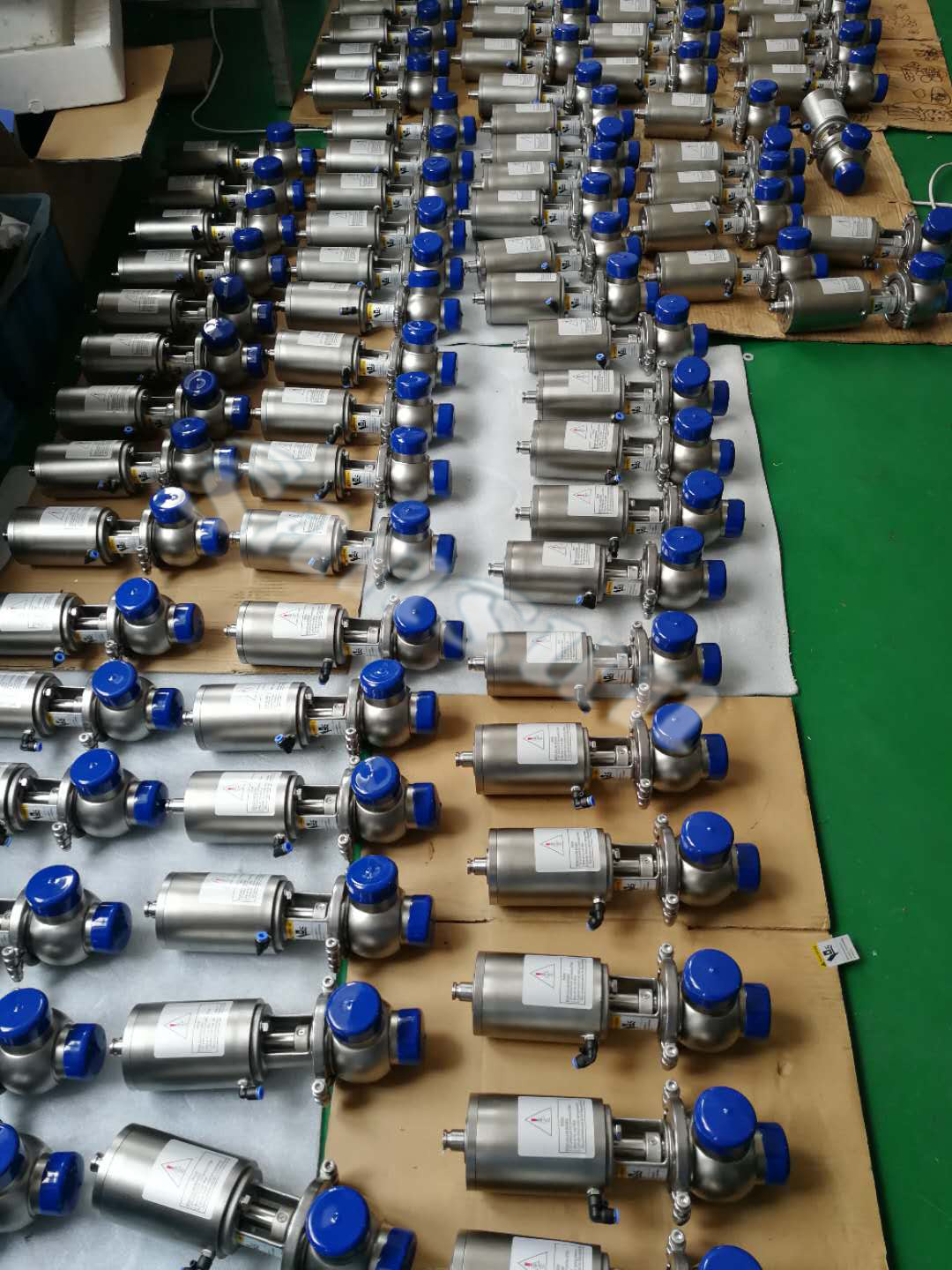
The stainless steel pneumatic sanitary reversing valve is mainly used for the purpose of reversing or stopping the medium. Because of its superior sealing and cleanability, it is widely used in various sanitary industries.

Working principle of sanitary pneumatic reversing valve:
Pneumatic cut-off/reversing valve series is to convert the energy generated by compressed air into mechanical energy, which will drive the axial movement of the valve stem, so that the position of the moving sealing component will control the opening and closing of the pipe port, and finally reach the medium For the purpose of reversing or staying, the manual cut-off reversing valve series is ultimately for the purpose of medium reversing or staying through manual manipulation of the handle.

Standard design of sanitary pneumatic reversing valve:
Various standard valve series can be provided to customers, namely for DIN standard series, 3A standard series, SMS standard series, ISO/IDF standard series, BS/RJT standard series, ASME/BPE and other standard series.

Reference for selection of sanitary pneumatic reversing valve:
This series of valves has two valve forms: cut-off type and reversing type. The cut-off type valve can be made with two or three pipe connections, and the reversing type valve can be made with three to five pipes. The diversity of interfaces fully meets the needs of the market.

For more detailed information, please visit our website http://www.sansunstainless.com or contact us at sansun05@sansunstainless.com.

sanitary stainless steel reversing valve

Professional Manufacturer/Factory of Sanitary Stainless Steel Bal Valve with Heat Preservation

Sanitary Food Grade Jacketed ball valve with Heat Preservation is largely use to sustain process media temperature during process to keep fluids at a lower viscosity to operate valve smoothly.

Sanitary Hygienic 3 way Jacketed ball valve with Heat Preservation is widely used in Food Process, like chocolate , and other anti-crystallization and heating insulation industry system.

The Sanitary Food Grade Jacketed ball valve with Heat Preservation is specially developed to maintain a temperature in the valve. The volume of steam or hot water in the jacket depends on the size of the ball valve.

For more detailed information, please visit our website http://www.sansunstainless.com or contact us at sansun05@sansunstainless.com.

sanitary ball valve with heat preservation

Manufacturer/Factory of Sanitary Bolted Spray Cleaning Ball

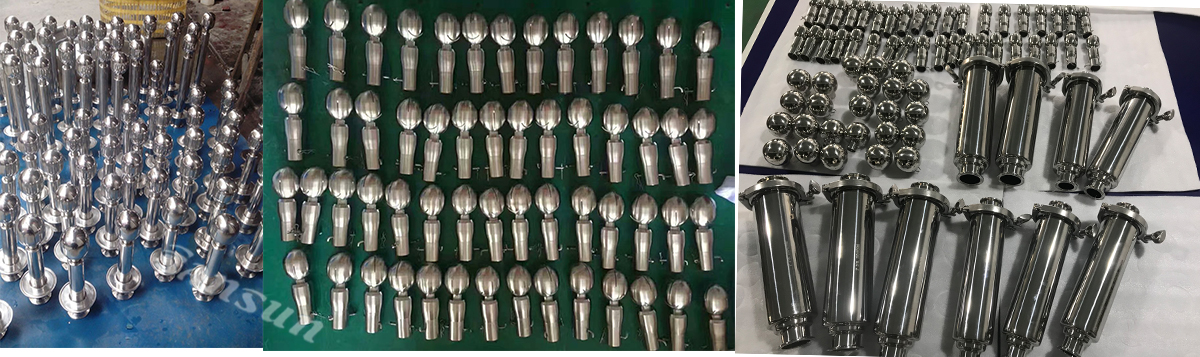
Sanitary cleaning ball are used to wash the inner surface of both horizontal and vertical containers. Cleaning ball for irrigation of surfaces with rinsing water and detergent solutions are stationary and portable. A stationary cleaning ball is installed, as a rule, in the upper part of the tank and is constantly in it, and a portable cleaning ball is in an open hatch only during tank cleaning.

Stationary cleaning balls are used in two types: non-rotating and rotating:

Non-rotating cleaning balls are a hollow ball-shaped or otherwise shaped head with round or slotted holes. The number of holes and their location should ensure uniform distribution of jets on the inner surfaces of the containers;

Rotating cleaning balls can be in the form of a ball-shaped head with tangential holes. When liquid jets exit from the holes, reactive forces arise, directed tangentially to the head surface. As a result, the cleaning balls acquires a rotational motion.

Rotating cleaning balls irrigate the inner surfaces of containers more intensively than non-rotating ones. Rinse water and cleaning solutions are supplied to the cleaning balls by a centrifugal pump, which takes them from special tanks.

For more detailed information, please visit our website http://www.sansunstainless.com or contact us at sansun05@sansunstainless.com.
saniatry cleaning ball
stainless steel cleaning ball

Manufacturer of Sanitary Food Grade Jacketed ball valve with Heat Preservation

Sanitary Food Grade Jacketed ball valve with Heat Preservation

 Sanitary Food Grade  heating jacketed ball valve

Sanitary Food Grade Jacketed ball valve with Heat Preservation for chocolate

Sanitary Food Grade Jacketed ball valve with Heat Preservation is largely use to sustain process media temperature during process to keep fluids at a lower viscosity to operate valve smoothly,

Sanitary Food Grade Jacketed ball valve with Heat Preservation is widely used in Food Process, like chocolate , and other anti-crystallization and heating insulation industry system.

The Sanitary Food Grade Jacketed ball valve with Heat Preservation is specially developed to maintain a temperature in the valve. The volume of steam or hot water in the jacket depends on the size of the ball valve,

SizesDN 8 to DN 150 /  1” to 4”
Reduce bore, Full bore, True bore
Max. pressure*100 bar
Temp. range-50°C to 280C
Type of connections– Butt weld, Socket weld, Thread (NPT and BSP), Triclamp ends, Orbital welding, DIN 11851
– Jacket: Thread
Weld connectionsISO, ASME, DIN, SMS, S10, S40
Material– Body, ball, connections: 304 /316L- Seats: PTFE
Operationmanual or actuator (electric or pneumatic)
Certificates3.1, FDA, CE (PED)

Professional Manufacturer/Factory of Sanitary Safety Valve

The safety valve is a relatively special branch of the valve family. Its particularity is because it is different from other valves that only play a role of switching, and more importantly, it plays a role in protecting the safety of the equipment.

Safety valves are generally divided into spring-type safety valves, lever-type safety valves, and pulse-type safety valves according to their structure. Among them, spring-type safety valves are commonly used; according to the connection method, they are divided into threaded safety valves and flange safety valves. The diameter of the safety valve is generally not large, the commonly used ones are between DN15mm-DN80mm, and more than 150mm are generally called large-diameter safety valves.

A safety valve is a special valve whose opening and closing parts are normally closed under the action of external force. When the medium pressure in the equipment or pipeline rises above the specified value, the medium is discharged outside the system to prevent the medium pressure in the pipeline or equipment from exceeding the specified value. .

Safety valves belong to the category of automatic valves, which are mainly used in boilers, pressure vessels and pipelines. The control pressure does not exceed the specified value and plays an important role in protecting personal safety and equipment operation. Note: The safety valve must be pressure tested before it can be used. Sanitary safety valves (including welded, fast-mounted, and free-to-use) safety valves are closed when the pressure is normal.

This safety valve is widely used in food, wine, beverages, dairy products, toothpaste cosmetics, biopharmaceutical and other industries.

For more detailed information, please visit our website http://www.sansunstainless.com or contact us at sansun05@sansunstainless.com.
sanitary stainless steel safety valve

Professional Manufacturer of Sanitary Stainless Steel Cleaning Ball

Sanitary cleaning ball is divided into: rotating sanitary cleaning ball/fixed sanitary cleaning ball/horn type sanitary cleaning ball/rotating sanitary tank washing device/fixed sanitary tank washing device/horn type sanitary washing tank Connectors, etc., the connection forms are: welded, fast-mounted, and threaded.

Rotary cleaning ball: Rotary cleaning ball is a kind of rotating spray head, which uses detergent to clean and spray the tank comprehensively. Because this equipment uses less washing liquid under low pressure, it is an effective alternative to traditional fixed spray balls. The use of double ball bearings in the rotating head makes this type of cleaning ball series suitable for all sanitary and industrial cleaning applications, including cleaning tasks for all sanitary and industrial products such as storage tanks, reactors and containers.

Working principle of cleaning ball:

Rotary cleaning ball: The cleaning liquid rotates the cleaning ball nozzle through its own power, and the fan-shaped jet forms a vortex in the entire tank and the reaction vessel, thereby effectively removing the residual products on the surface of the container and achieving a cleaning effect.

Fixed cleaning ball: The cleaning ball passes through the nozzle small opening of the cleaning ball to form a jet that sprays around, thereby removing the residual product left on the surface of the container and achieving a cleaning effect.

For more detailed information, please visit our website http://www.sansunstainless.com or contact us at sansun05@sansunstainless.com.

saniatry cleaning ball

Manufacturer of Sanitary Aseptic Sampling Valve SS304/316L

The aseptic sampling valve is a special valve used for disinfection and sterilization before and after each sampling operation

The structure of aseptic sampling valve mainly includes sealing rubber sleeve, sample storage cavity, sampling port, stainless steel thimble, spring, thimble cannula, manual rotary handle (the difference between automatic aseptic sampling valve and manual is whether pneumatic device is used, the basic principle In the same way, aseptic sampling valves are normally equipped with sampling port seals of appropriate size).

Its basic working principle is that when it is in the closed state, the thimble is pushed by spring tension or other pressure, and the sealant head is pressed against the opening of the tank wall by the thimble to achieve the sealing effect. If sampling is required, steam or other sterilizing medium is introduced from one of the sampling ports, and the entire sample storage cavity is filled with steam and exported from the other sampling port. After a certain period of time, the sample storage cavity and the sampling port are sterile. status. Then, by twisting the handle, contracting the spring and relaxing the thimble, the sealant head is separated from the opening on the tank wall, so that the sample flows out of the tank through the sample chamber and is collected from the sampling port. After sampling, turn the handle to relax the spring, and press the sealant head against the opening of the tank wall through the thimble again.

The application media of the aseptic sampling valve are cold wort, fermentation broth, yeast mud, deoxygenated water, sake, sterile water, etc.

For more detailed information, please visit our website http://www.sansunstainless.com or contact us at sansun05@sansunstainless.com.

Professional Manufacturer of Sanitary Lobe Pump

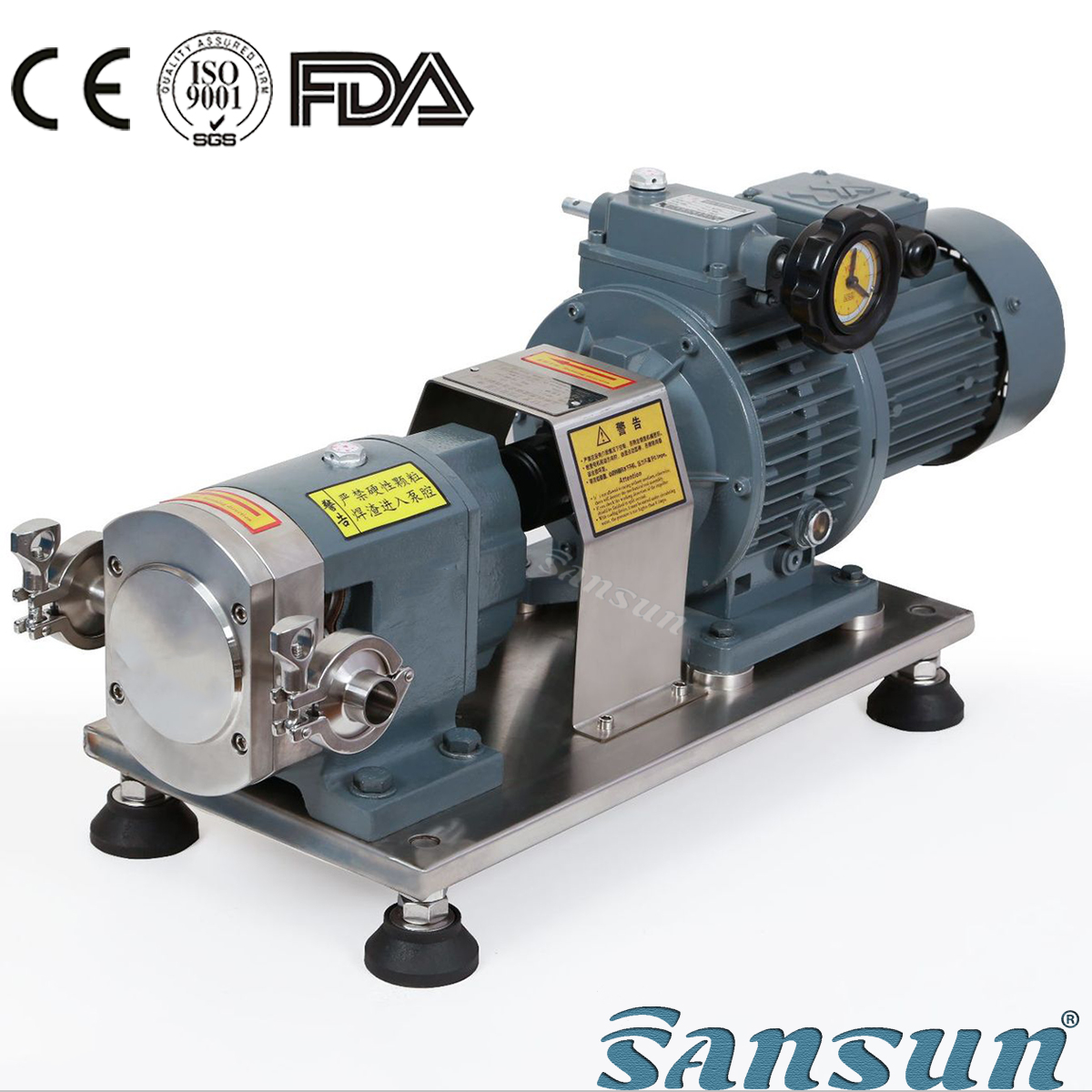
Rotor pumps are also called colloid pumps, lobe pumps, three-lobe pumps, universal transfer pumps, etc., and rotor pumps are positive displacement pumps. It achieves the purpose of transporting fluid by means of the periodic conversion of multiple fixed-volume transport units in the working chamber. The mechanical energy of the prime mover is directly converted into the pressure energy of the conveying fluid by the pump. The flow rate of the pump depends only on the volume change value of the working chamber and its change frequency per unit time, and (theoretically) has nothing to do with the discharge pressure; the rotor pump is working In the process, a pair of synchronously rotating rotors is actually used to achieve the purpose of conveying materials.

The coupling is assembled as a whole to make the volume smaller (the length can be shortened by 100-250mm), reduce the footprint, compact structure, stainless steel outsourcing, mirror polishing, beautiful appearance, high-grade, and avoid the peeling of the original paint. Performance optimization: the use of the coupling as a whole is assembled to reduce the power consumption of the elastic coupling, noise and wear replacement to improve work efficiency, and obtain the highest efficiency, the smallest internal sliding and a longer service life.

The rotor pump relies on two synchronous and counter-rotating rotors (the number of teeth is 2-4) to generate suction (vacuum) at the inlet during the rotation, thereby sucking in the material to be transported. The two rotors divide the rotor chamber into several small spaces and run in the order of a→b→c→d. When running to position a, only chamber I is filled with medium; when reaching position b, part of the medium is closed in chamber B; when reaching position C, chamber A is also closed with medium; when reaching position d, chamber A and chamber Ⅱ The chambers are connected, and the medium is delivered to the outlet. In this way, the medium (material) is continuously transported out.

Application:

  1. Food and beverages: dairy, latex, chocolate, syrup, cheese, wort, beer, soda
  2. Fruit concentrates: pudding, jam, jelly, tomato sauce
  3. Paste products: fats and oils, etc.
  4. Cosmetics: creams, detergents, hair gels, perfume oils, etc.
  5. Drugs: extract, emulsion, pill slurry, etc.
  6. Chemical industry: dyes, fats, solvents, resins and polymers

For more detailed information, please visit our website http://www.sansunstainless.com or contact us at sansun05@sansunstainless.com.

sanitary lobe pump
sanitary lobe pump